
A smrtr Guide for Manufacturers
Manufacturing compliance isn’t a once-a-year checkbox. It’s a daily operational reality — and for most manufacturers, the biggest threat to staying compliant isn’t a lack of standards awareness. It’s the document management system (or lack of one) sitting behind every process.
When an auditor walks in the door, when a regulator requests records, when a quality incident triggers a full trace-back, the question isn’t whether your team knows the rules. It’s whether your documents tell the right story — quickly, completely, and without gaps.
For most manufacturers, that’s where things break down. Not because the documentation doesn’t exist, but because the systems managing it create the very compliance risks they’re supposed to prevent.
Here’s what actually causes compliance issues in manufacturing document management — and what it takes to solve them.
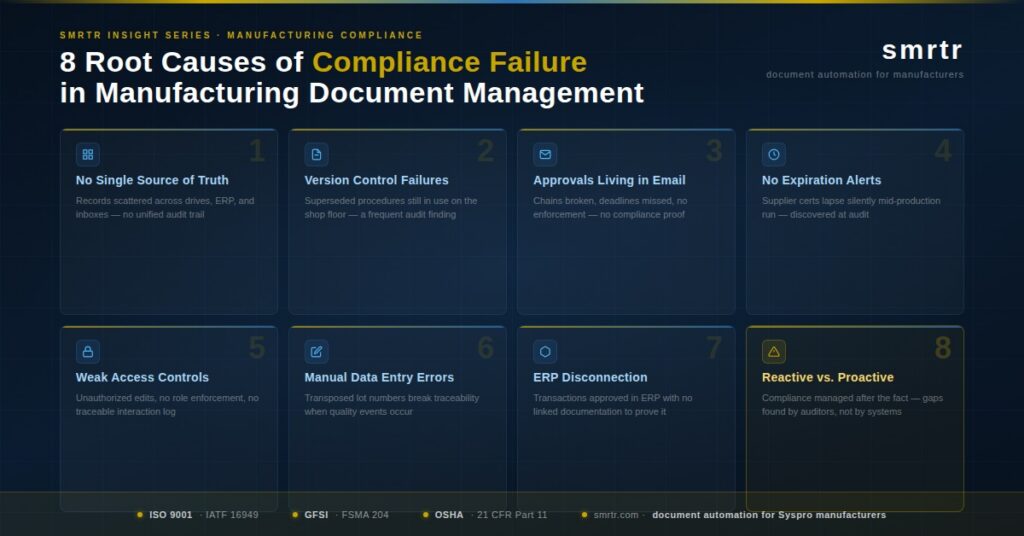
1. No Single Source of Truth
In most manufacturing environments, documents don’t live in one place. Engineering drawings are in one folder. Quality certifications are in another. Supplier compliance records are attached to emails. Batch records are in the ERP. Safety documentation is printed and filed in a binder on the shop floor.
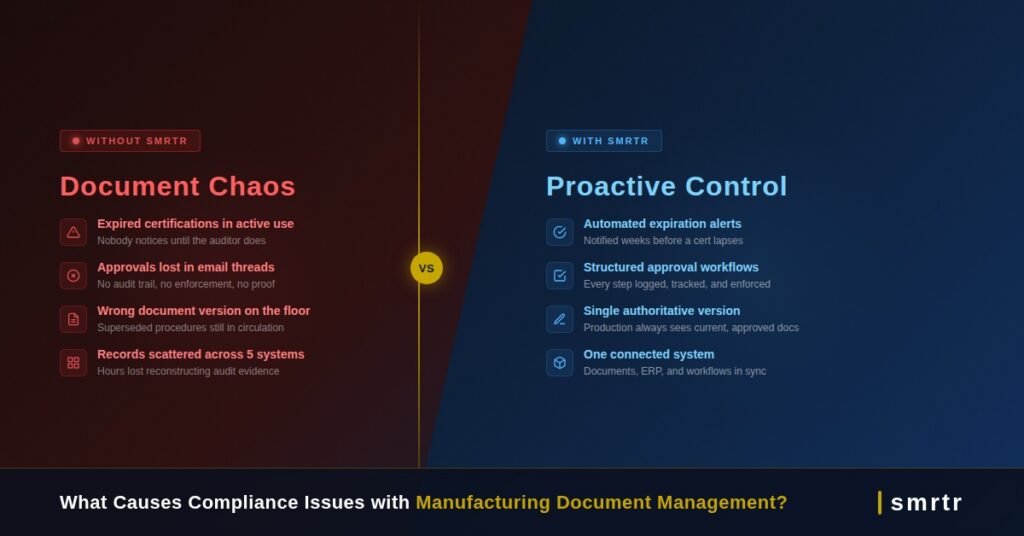
When compliance depends on pulling those records together — quickly, accurately, and with a complete audit trail — a fragmented document environment is a liability. Teams spend hours reconstructing information that should be instantly accessible. Records get missed. Versions get confused. And auditors don’t give partial credit.
The root cause is simple: documents are stored where they’re created, not where they’re needed. A true document management system centralizes records so that every relevant document — regardless of where it originated — is accessible from a single, searchable location indexed by the business values that matter: lot number, supplier, product, work order, date range, certification type.
smrtr is built around this principle. When a document enters the system, it’s captured, indexed, and connected to the business context it belongs to — so when compliance requires it, it’s there.
2. Version Control Failures
Manufacturing compliance frameworks — ISO 9001, IATF 16949, GFSI, OSHA, FDA 21 CFR Part 11 — all share a common requirement: the right people must be working from the right version of every document, every time.
That sounds straightforward. In practice, it’s one of the most common sources of compliance failures in manufacturing.
When documents are stored in shared drives, email inboxes, or loosely managed digital folders, version control becomes a manual discipline. Someone downloads a document to edit it. Someone else is still using last month’s version. A revision gets updated in one location but not another. The shop floor keeps printing from a template that was superseded two revisions ago.
The consequences range from minor inconsistencies to serious quality failures — and when an auditor asks for documentation proving that approved procedures were followed, “we think that’s the current version” is not an acceptable answer.
Effective version control in manufacturing requires more than just numbering revisions. It requires:
- A controlled document repository where only the current version is accessible to production users
- Automatic notifications when a document is updated or revised
- A clear approval workflow before a new version becomes active
- Audit-ready history showing who approved what, and when
smrtr enforces version control at the system level — not through hope and habit. Controlled documents have a single authoritative version. Previous versions are retained for audit purposes but are not accessible to standard users. Revisions trigger configurable approval workflows before they go live. Every interaction is logged.
3. Approval Workflows That Live in Email
Routing a document for approval through email is one of the most reliable ways to create a compliance gap.
It feels efficient in the moment. A quality manager sends a revised procedure to three people for sign-off. Two respond. The third is out of office. The document gets used anyway because production can’t wait. The approval chain is never completed and nobody documents the exception. Six months later, an auditor asks for evidence of controlled document approval and the trail leads nowhere.
Compliance standards don’t just require that documents be approved — they require that the approval process be documented, traceable, and defensible. Email doesn’t do that. Email archives are inconsistent, hard to search, and provide no enforcement. Approvals get buried in threads. Deadlines aren’t tracked. Escalations don’t happen automatically.
A proper document management system replaces ad-hoc email routing with structured, automated approval workflows. Reviewers are notified automatically. Deadlines are tracked. Escalations trigger when a reviewer is unresponsive. Every approval step — who reviewed it, when, and what decision they made — is captured in an immutable audit log. The document cannot move to the next stage until the workflow requirements are met.
For manufacturers operating under ISO, GFSI, or FDA requirements, this isn’t a nice-to-have. It’s the difference between a compliant process and one that exists on paper but can’t be proven.
4. No Automated Alerts for Expiring Documents
Supplier certifications expire. Safety training lapses. Equipment calibration schedules pass. Quality approvals hit their review date and nobody notices.
For manufacturers with dozens of suppliers and hundreds of controlled documents, tracking expiration dates manually is not a sustainable compliance strategy. Spreadsheets get out of date. Reminders get missed. And when a supplier’s certificate of compliance expires quietly in the middle of an active production run, the resulting quality or regulatory exposure can be significant.
Compliance requires that manufacturers not just hold the right documents — but that those documents remain current and valid throughout the relationship or production cycle. An audit that reveals expired certifications in active use is a serious finding, regardless of whether the actual materials met spec.
smrtr solves this at the infrastructure level. Expiration dates are captured as indexed properties when documents are ingested. Automated alerts notify relevant stakeholders — procurement, quality, supplier management — before documents expire, with configurable lead times. When a document lapses, the system can trigger a hold workflow, preventing the associated supplier or material from being approved for use until updated documentation is received.
Instead of discovering expired records during an audit, you’re managing them proactively — before they become a compliance event.
5. Weak or Missing Access Controls
Not every employee should have access to every document. That’s not just a security principle — it’s a compliance requirement under many frameworks.
When access controls are weak or absent, documents can be modified without authorization. Sensitive records — proprietary formulations, supplier contracts, personnel files — can be accessed by people with no legitimate business need. And when an auditor asks who had access to a controlled document and when, the answer “everyone with network access” is a red flag.
Proper document management in manufacturing requires role-based access control: the ability to define, for each document type or category, exactly who can view, edit, approve, and distribute. It requires an audit trail that captures every interaction — who opened a document, who downloaded it, who made a change, and when. And it requires that those controls be enforced by the system, not by informal policy.
smrtr implements configurable role-based access across all document types. Access is defined by role, not by individual — making it scalable and auditable as organizations grow and change. Every document interaction is logged and reportable. When compliance requires demonstrating controlled access, the evidence is already there.
6. Manual Data Entry Creates Records That Don’t Match Reality
A compliance record is only as reliable as the data inside it. And in manufacturing environments where document data is still being manually keyed — batch numbers transcribed from physical labels, inspection results typed from handwritten sheets, supplier data re-entered from emailed certificates — the gap between the record and reality grows with every human touch.
Manual entry errors are not hypothetical. They happen every day in manufacturing operations that haven’t automated document capture. A transposed digit on a lot number. A wrong date on a receiving record. A supplier code entered incorrectly that breaks the traceability chain. These errors don’t always cause immediate problems. But when a product quality event triggers a trace-back and the records don’t align, the compliance exposure — and the customer relationship damage — can be severe.
smrtr’s intelligent capture eliminates much of this risk. Rather than relying on employees to manually re-enter data from documents, smrtr uses OCR, barcode recognition, and database validation to capture and verify document data at the point of ingestion. Information is checked against your ERP records before it’s accepted. Discrepancies are flagged for review rather than silently entering the system.
The result is a document record that actually reflects what happened — traceable, accurate, and defensible when compliance requires it.
7. Disconnection from the ERP
For manufacturers using an ERP — whether Syspro, SAP, or any other platform — the ERP is the system of record for transactions. But compliance doesn’t live only in transactions. It lives in the documents that surround them: the purchase order that initiated a buy, the inspection record that cleared the material, the supplier certificate that authorized the source, the work order that drove the production run.
When the ERP and the document management system are disconnected — or when the ERP’s native document tools are too limited to manage controlled documents, workflows, and compliance tracking — manufacturers end up with two separate realities. The ERP says the material was approved. The document system can’t prove it. Or the document system has the certificate, but it’s not linked to the transaction that used it.
An integrated approach connects the document record to the ERP transaction it belongs to — bidirectionally. smrtr exchanges data with Syspro and other ERP platforms so that the documents, the workflows, and the transactions stay aligned. When an auditor asks for the complete record supporting a production run, it’s not a scavenger hunt across two systems. It’s one connected view.
8. Reactive Compliance Instead of Proactive Control
The most fundamental compliance problem in manufacturing document management isn’t any single gap — it’s the posture many organizations take toward compliance itself.
When document management is treated as a storage problem rather than a process problem, compliance becomes reactive. Auditors find gaps that teams then scramble to fill. Expired records are discovered after the fact. Version control failures surface during quality events rather than being prevented by system controls. Approval workflows fail silently because nobody built the enforcement in.
Proactive compliance requires a document management foundation that enforces the right behaviors by design — version control that can’t be bypassed, approval workflows that can’t be skipped, access controls that can’t be worked around, expiration alerts that trigger before the lapse, and audit trails that document everything automatically.
That’s not a description of a file storage system. It’s a description of smrtr.
The Cost of Getting This Wrong
Compliance failures in manufacturing are expensive — far more expensive than the investment in systems that prevent them.
Regulatory fines and production shutdowns are the most visible consequences. But the broader damage — to customer relationships, supplier trust, quality certifications, and brand reputation — compounds over time. And for manufacturers in regulated sectors like food and beverage, pharmaceuticals, automotive, or aerospace, a significant compliance finding doesn’t just create a fine. It can cost certifications that took years to earn.
Document management isn’t a back-office administrative function. For manufacturers, it’s a core operational capability — one that either supports compliance or quietly undermines it, depending on how it’s built.
smrtr is purpose-built for manufacturers who can’t afford the latter.
Want to see how smrtr helps manufacturing teams build a compliant, audit-ready document infrastructure?
Contact smrtr today at smrtrsolutions.com