
Your supplier paperwork is either an asset or an audit finding. There’s no third option.
An expired allergen statement costs nothing until an auditor finds it. A missing lot code costs nothing until a retailer rejects a shipment, or the FDA asks for 24 hours of traceability records you can’t produce. For food and beverage manufacturers, supplier management isn’t a procurement nicety. It’s the gap where fines, chargebacks, and recalls get in.
The market for supplier management platforms is crowded, and much of it wasn’t built for food. Some tools are enterprise procurement platforms designed for indirect spend. Some are restaurant back-office apps. Some are strong on documents but stop at the edge of your ERP. This guide compares the main options with the lens that matters most to food manufacturers in 2026: FSMA 204 readiness, traceability support, and how well each tool handles the supplier documentation work your quality team does every day.
FSMA 204: the deadline moved, the pressure didn’t
The FDA’s Food Traceability Rule, FSMA 204, requires companies that manufacture, process, pack, or hold foods on the Food Traceability List to keep enhanced traceability records. Covered companies must assign Traceability Lot Codes (TLCs), capture Key Data Elements (KDEs) at Critical Tracking Events (CTEs), and produce records to the FDA within 24 hours of a request. reliamag
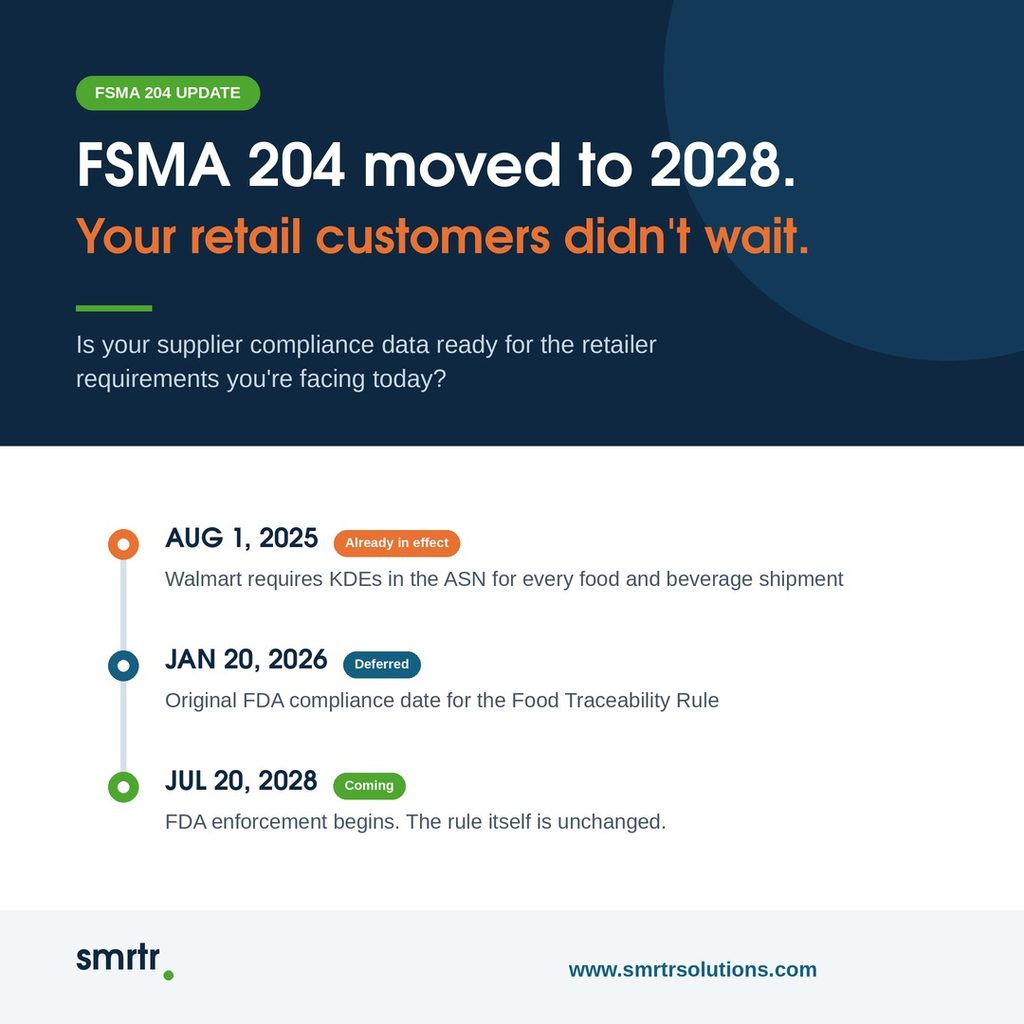
The original compliance date was January 20, 2026. In November 2025, Congress passed the Continuing Appropriations Act of 2026, which directed the FDA not to enforce the rule before July 20, 2028. The rule itself is unchanged; only the compliance and enforcement date moved. reliamag
Treating that extension as breathing room is a mistake, because your customers aren’t waiting. As of August 1, 2025, Walmart requires all food and beverage suppliers to submit an ASN containing KDEs for every shipment. Walmart, Kroger, and Albertsons are all writing FSMA 204 traceability clauses into supplier contracts, and some of those requirements apply regardless of the FDA’s enforcement date. The practical deadline for many manufacturers has already passed. The only question is whether your data can keep up. truecommercethecanary
What a food manufacturer should expect from a supplier management platform
Generic supplier relationship management (SRM) criteria, such as onboarding speed, scorecards, and spend visibility, still apply. Food manufacturing adds requirements that most procurement platforms treat as edge cases.
Supplier documentation workflows. Certificates of analysis, GFSI audit certificates, allergen statements, certificates of insurance, and specifications all come with expiration dates and approval steps. The platform should request, collect, route, approve, and renew these documents automatically. A shared folder with a spreadsheet tracker doesn’t qualify.
Traceability data, not just traceability documents. A certificate proves a supplier is approved. FSMA 204 needs lot-level KDEs tied to receiving, transformation, and shipping events. Ask whether the tool captures that data or only stores PDFs about it.
ERP integration. Supplier approval status belongs in the place where buyers raise purchase orders and receivers accept deliveries. If the compliance tool and the ERP disagree about whether a supplier is approved, the ERP usually wins, and the unapproved ingredient ends up on your dock.
Trading-partner connectivity. Retailer ASN and KDE requirements run on EDI. A supplier compliance tool that can’t connect to your EDI flows leaves the most time-sensitive part of FSMA 204 to manual rekeying.
Audit readiness. When an auditor or the FDA asks for a record, the question is how long it takes to produce it and whether you trust what you produce.
Time to value. Implementation timelines in this category vary widely, from weeks to more than a year. Every month of implementation is another month of manual risk.
The platforms compared
Food manufacturers usually find the options fall into five groups. Each group has a different center of gravity, and knowing which one you’re buying from matters more than any feature checklist.
Food-specific supplier compliance platforms
TraceGains is one of the most established names in food supplier compliance. It centralizes supplier documents, COAs, and specifications, and automates onboarding. Independent reviewers point to its built-in lot traceability, which links lots to supplier-sourced inputs for investigation workflows, as its standout capability. The tradeoff is setup: document requirements have to be mapped to workflow steps before the system delivers value. One competitor review estimates implementation at two to six months and notes user complaints about a dated interface and heavy notification volume. zipdoalleratech
SafetyChain covers supplier quality alongside audits, specifications, and production data. Reviewers describe it as keeping supplier records and approval status in a single working queue, with the caveat that it works best when teams follow its defined workflow and is less suited to suppliers with irregular documentation. zipdo
ReposiTrak focuses on shared supplier documentation between buyers and suppliers, with expiry tracking and structured review cycles, though setup requires careful mapping of document types and review steps. zipdo
Allera is a newer entrant that emphasizes supplier experience. Suppliers respond through a link without creating an account, renewals pre-fill from the last approved submission, and the company cites roughly 30 days to go live. It runs alongside your ERP rather than inside it. alleratech
Traceability-first platforms
FoodLogiQ (Trustwell) starts from traceability and recall management and builds supplier management around it. It supports FSMA 204 KDE and CTE capture, lot-level tracking, and recall workflows. Reviewers flag a high entry cost and implementation that can take four to nine months. It’s a strong fit for brands whose top concern is recall response speed. alleratech
Food safety and quality management systems
Safefood 360° and ETQ Reliance are quality management systems with supplier modules. They’re strongest when your supplier program sits inside a broader HACCP, CAPA, and audit management effort. Both carry longer implementations and steeper learning curves, with ETQ positioned for enterprise, multi-plant operations. If you mainly need supplier compliance, you may pay for a lot of QMS you won’t use. alleratech
Enterprise procurement and SRM platforms
SAP Ariba, Coupa, Jaggaer, Ivalua, and Kodiak Hub appear on most general “best supplier management software” lists. These lists typically rank them on supplier risk visibility, spend management, source-to-pay workflows, and ESG monitoring. They’re capable vendor management and procurement platforms, but they’re designed around sourcing and spend rather than lot codes and allergen statements. Food manufacturers who pick one often end up bolting on a separate compliance tool. highradius
ERP-embedded options
INECTA, a food ERP built on Microsoft Dynamics 365 Business Central, puts supplier compliance and lot tracking inside the ERP itself. The tradeoff is scope: it’s a full ERP decision, with first-year costs estimated around $150,000 and implementation timelines of nine to 18 months. That makes sense if you’re replacing your ERP anyway, and much less if you’re not. alleratech
A note on restaurant tools: several “food supplier management” rankings include products like MarginEdge, xtraCHEF, MarketMan, and Choco. These are built for restaurant purchasing and back-office work. They don’t address manufacturing traceability or FSMA 204 recordkeeping, so manufacturers can leave them off the shortlist.
At a glance
| Platform type | Examples | Strongest at | Watch out for |
|---|---|---|---|
| Food supplier compliance | TraceGains, SafetyChain, ReposiTrak, Allera | Document collection, approvals, renewals | Separation from the ERP; setup mapping |
| Traceability-first | FoodLogiQ (Trustwell) | Lot tracking, recall response, FSMA 204 KDEs | Cost and implementation time |
| Food safety QMS | Safefood 360°, ETQ Reliance | HACCP, CAPA, audits across plants | Paying for more than supplier compliance |
| Enterprise SRM/procurement | SAP Ariba, Coupa, Jaggaer, Kodiak Hub | Spend, sourcing, supplier risk, ESG | Weak fit for food documentation and traceability |
| ERP-embedded | INECTA | Single system of record | Requires an ERP replacement |
| Syspro-native | smrtr TRAC, ePOD, AXIS | Compliance and traceability inside Syspro | Built for Syspro environments |
Where smrtr fits
Most of the platforms above ask food manufacturers to accept a tradeoff: either keep supplier compliance outside the ERP and reconcile the two, or replace the ERP to bring them together. For the thousands of food and beverage manufacturers running Syspro, smrtr removes that tradeoff.
smrtr’s TRAC supplier compliance solution manages supplier documentation, approvals, and expirations with deep Syspro integration. That means approval status is visible where purchasing and receiving actually happen, not in a separate portal someone has to remember to check. Around TRAC, smrtr connects the other pieces FSMA 204 depends on: EDI for the ASN and KDE data retailers now demand, ePOD to capture proof of delivery at the point of handoff, and AXIS document management to keep every certificate, COA, and delivery record searchable when an auditor or the FDA calls.
The result is a supply chain management record that holds up under pressure. The same system your team already runs on can show who supplied what, when it shipped, where it went, and whether the paperwork was current.
smrtr serves more than 800 customers globally across manufacturing, food and beverage, and distribution. If Syspro is your ERP, it’s worth asking whether your supplier compliance stack is working with it or around it.
How to choose: five questions for your shortlist
Before you book demos, answer these internally. They’ll narrow the field faster than any feature grid.
- Where is your supplier approval status used? If buyers and receivers need to see it in the ERP, integration depth matters more than portal polish.
- Do you need traceability data or traceability documents? FSMA 204 requires the data. Many supplier management platforms only handle the documents.
- What do your retail customers already require? If you ship to Walmart, Kroger, or Albertsons, your EDI and ASN capability is a compliance issue, not an IT issue.
- How long can you afford to implement? Compare go-live estimates honestly. Nine months of implementation is nine months of manual exposure.
- Are you buying supplier compliance or a whole QMS? Both are valid purchases. They’re not the same purchase.
Frequently asked questions
What is a supplier management platform?
A supplier management platform centralizes supplier information, documentation, approvals, and performance in one system. For food manufacturers, it also has to manage food safety documentation, such as COAs, allergen statements, and GFSI certificates, and support the traceability records FSMA 204 requires.
Is supplier management the same as supplier relationship management?
They overlap. Supplier relationship management usually focuses on strategic performance, collaboration, and risk, while supplier compliance focuses on qualification, documentation, and regulatory readiness. Food manufacturers typically need strong supplier compliance first.
When is the FSMA 204 compliance date?
July 20, 2028. The original deadline was January 20, 2026, but Congress directed the FDA not to enforce the rule before July 2028. The rule itself has not been repealed or altered. thecanary
Do general procurement platforms handle FSMA 204?
Most enterprise procurement platforms are built for sourcing and spend management. They can store supplier certificates, but they generally don’t capture lot-level KDEs at critical tracking events, which is the core of FSMA 204.
Should supplier compliance live inside the ERP?
It should at least be tightly integrated with it. When supplier approval status lives only in a separate tool, purchasing and receiving teams can act on outdated information. ERP-native or deeply integrated supplier compliance closes that gap.
The FDA gets 24 hours. How long does your spreadsheet take?
See how smrtr connects supplier compliance, EDI, and traceability inside Syspro. Visit www.smrtrsolutions.com to talk with our team.