
By Addison G. smrtr Team
smrtr isn’t simply an AP automation solution.
It connects AP automation with operational automation.

The manufacturing AP problem no one talks about
Spend a few minutes on the production floor of almost any mid-sized manufacturer, and you’ll see systems built for consistency. Every process is designed to reduce waste, maintain tight tolerances, and catch defects before they move downstream.
The finance department often tells a different story.
Invoices arrive from every direction, from email, PDFs, EDI, even paper. Purchase orders live in the ERP, while goods receipts sit in a warehouse management system. Before an invoice can be approved, someone has to compare all three documents, often by hand. And they’re not doing it once, they’re repeating the same process hundreds of times every week.
It’s a surprising disconnect. Manufacturers invest heavily in streamlining production, yet one of the most critical financial workflows often remains slow and manual.
The impact shows up in the numbers. According to Ardent Partners’ AP Metrics That Matter in 2025, best-in-class AP teams process invoices in an average of 3.1 days. Manufacturing organizations, on average, take 17.4 days. A major reason for that difference is whether three-way matching is automated or still relies on manual review.
For finance leaders, that’s more than an efficiency issue. Longer processing times can delay payments, increase the risk of errors, strain supplier relationships, and make it harder to maintain visibility into cash flow.
In this article, we’ll look at what makes accounts payable in manufacturing uniquely challenging and the platforms worth considering.
What makes manufacturing AP different
There are four layers of complexity that generic invoice processing software is simply not built for.
- Partial receipts. A supplier ships 800 units against a PO for 1,000. The invoice arrives at 800. Does your system match that correctly, hold the remaining 200, and reconcile when the second shipment arrives? Generic tools usually can’t — they flag it as an exception and drop it in someone’s queue.
- Configurable tolerances. Raw material prices fluctuate. Freight surcharges appear. Minor quantity variances happen at goods receipt. Best-in-class systems apply configurable tolerance thresholds — typically 2–5% on price, with separate thresholds by material category — so routine variances clear automatically without human intervention.
- Service entry sheets. For contract labor, maintenance, and subcontracted work, there is no physical goods receipt. Manufacturing AP platforms must validate service entry sheets before releasing payment, just as they validate goods receipts for physical deliveries.
- Exception handling by operational owner. When an invoice throws an exception, the right person to resolve it is rarely the AP team. A quantity discrepancy goes to receiving. A price variance goes to procurement. A missing receipt goes to the warehouse. Platforms built for manufacturing route exceptions to the right operational owner — not a generic AP queue where they sit until someone figures out who should handle it.
Most AP platforms only see what the ERP tells them. A platform connected to your receiving dock, your suppliers, and your logistics partners sees the full picture — which means it can tell you why an invoice doesn’t match, not just flag that it doesn’t.
How three-way matching works — and where it breaks down
Three-way matching verifies that three documents tell the same story before any invoice is approved for payment: the purchase order, the goods receipt, and the supplier invoice. A company should only pay for what it ordered and received; at the price it agreed.
In practice, the breakdown happens at system boundaries. Invoices arrive by email, EDI, and supplier portals. POs live in the ERP. Receipts sit in the warehouse management system. Without tight manufacturing ERP integration, matching becomes a manual scavenger hunt across three disconnected systems.
The exception rate tells the story. Ardent Partners found the average invoice exception rate is at 22%, while best-in-class teams hold it to 9%. Roughly one in five invoices at a typical manufacturer needs a human to stop and investigate — and in multi-plant environments, that ratio runs worse.
When three-way matching is automated correctly, many invoices fall within tolerance thresholds and post automatically to the ERP. The remainder are routed as categorized exception cases to the right operational owner — not dumped into a central queue.

The AP Automation Platforms Mid-Sized Manufacturers Are Actually Using
The AP automation market has no shortage of options — but most platforms were not built with manufacturing complexity in mind. Here is an honest look at the landscape, and why mid-market manufacturers keep landing on smrtr.
The enterprise platforms — SAP Ariba and Oracle Fusion Payables — offer deep three-way matching and strong procurement integration, but they come with enterprise-grade cost, implementation timelines, and IT requirements to match. For manufacturers above $500M in revenue already running SAP or Oracle as their core ERP, they can be the right fit. For everyone else, they are frequently over-engineered for the problem and under-suited for the budget.
SAP Concur Invoice, Stampli, and Tipalti each do specific things well — expense management, collaborative approvals, and global supplier payments respectively — but none were designed around the matching complexity manufacturing creates. Partial receipts, configurable tolerances by material category, and service entry sheet validation are not edge cases in a manufacturing environment. They are daily realities. When manufacturers pressure-test these platforms against those requirements, gaps tend to appear quickly.
Coupa and Medius are broader AP tools with solid market presence. The question for manufacturers is always matching depth at the operational level — whether the platform can handle the way your plant actually receives goods, not just the way a standard PO flow is supposed to work.
Infor is worth a look for manufacturers already running Infor CloudSuite or M3, where native ERP integration removes one layer of complexity. The honest question is whether the native AP module handles exception routing and multi-plant matching at the depth a growing manufacturer needs, or whether a purpose-built automation layer still makes sense on top of it.
Traild is the primary Syspro-specific competitor in this space and a credible option for Syspro users. When comparing smrtr and Traild side by side, the evaluation typically comes down to three things: depth of exception handling across multiple plants, the implementation and ongoing support model, and total cost over the first two years.
That is where smrtr AP is built to win. Purpose-built for mid-market manufacturers, distributors, and food and beverage companies running Syspro, SAP, VAI, NCR, and NetSuite. smrtr operates at line-item matching level with configurable tolerances, handles partial receipts and service entry sheet validation natively, and routes exceptions to the correct operational owner at the correct plant. Pre-built ERP integration means go-live in under 30 days with no changes to your chart of accounts or vendor master. Processing cost drops from $14.32 per invoice to under $2.50. Most customers see full payback within their first quarter.
Multisite AP: where most platforms fall short
For manufacturers running more than one facility, AP automation is not just about processing speed — it is about control. Each plant may have its own purchasing team, its own suppliers, its own receiving dock, and its own coding requirements. An invoice from a shared supplier might need to split across three plants. A goods receipt confirmed at Plant B might need to match a PO raised at Plant A.
Multisite AP solutions need entity-level separation, plant-level approval workflows, consolidated reporting across all sites, and exception routing to the right contact at the right plant. This is where most generic platforms fall short — they handle the invoice side competently but don’t account for the operational interdependency between finance and production in a multi-plant environment.
The cost of not moving
At an industry average of $14.32 per invoice processed manually, a mid-market manufacturer handling 2,000 invoices per month is spending over $340,000 per year just to pay its bills. That is before late fees, missed early payment discounts, and the AP headcount request that gets approved every time invoice volume spikes.
According to PwC’s 2024 CFO Pulse Survey, only 36% of CFOs currently use AI or process automation in accounts payable. That gap is closing fast. The manufacturers who move first are not just reducing AP cost — they are using faster payment cycles to negotiate better supplier pricing, closing the books faster, and giving their finance teams time to focus on decisions instead of data entry.
Is smrtr AP right for your operation?
smrtr AP is built for mid-market manufacturers, distributors, and food and beverage companies running Syspro, VAI, SAP, NCR, or NetSuite — typically processing between 500 and 10,000 invoices per month across one or more plants.
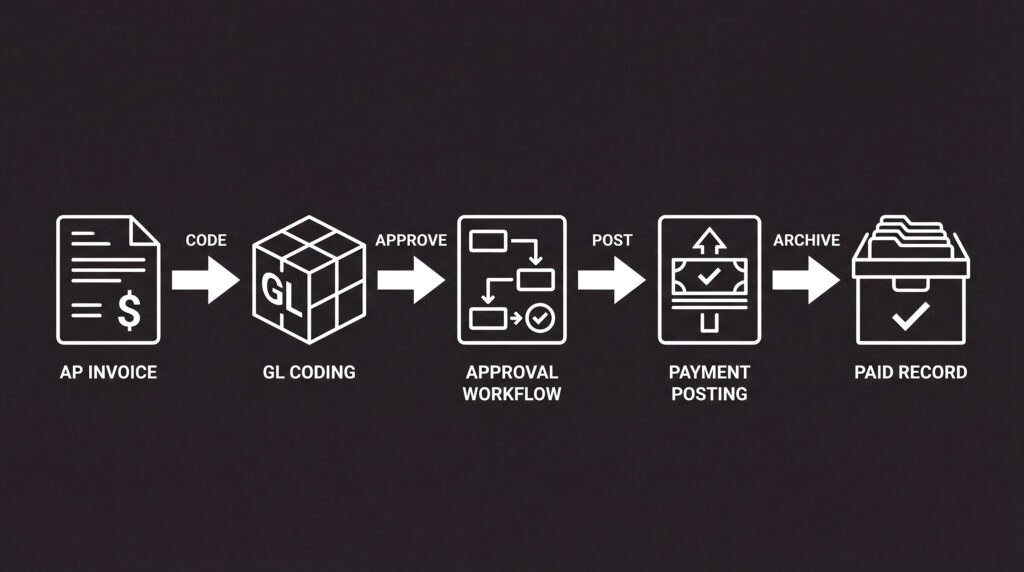
It handles every format an invoice arrives in, matches at line-item level against your POs and goods receipts, validates service entry sheets, routes exceptions to the right operational owner at the right plant, and archives every document it touches in a fully searchable audit trail. Pre-built ERP integration means your team is processing live invoices in under 30 days — no custom development, no disruption to existing workflows.
The number that tends to end the conversation: the industry average cost to process a single invoice manually is $14.32. smrtr brings that under $2.50. For most mid-market manufacturers, that math pays back the full investment within the first quarter.
Want to see what your current AP process is costing you — and benchmark it against manufacturers your size?
Request a free AP assessment at https://smrtrsolutions.com
Walk away knowing your cost per invoice, your exception rate, and where you’re leaving money on the table.